
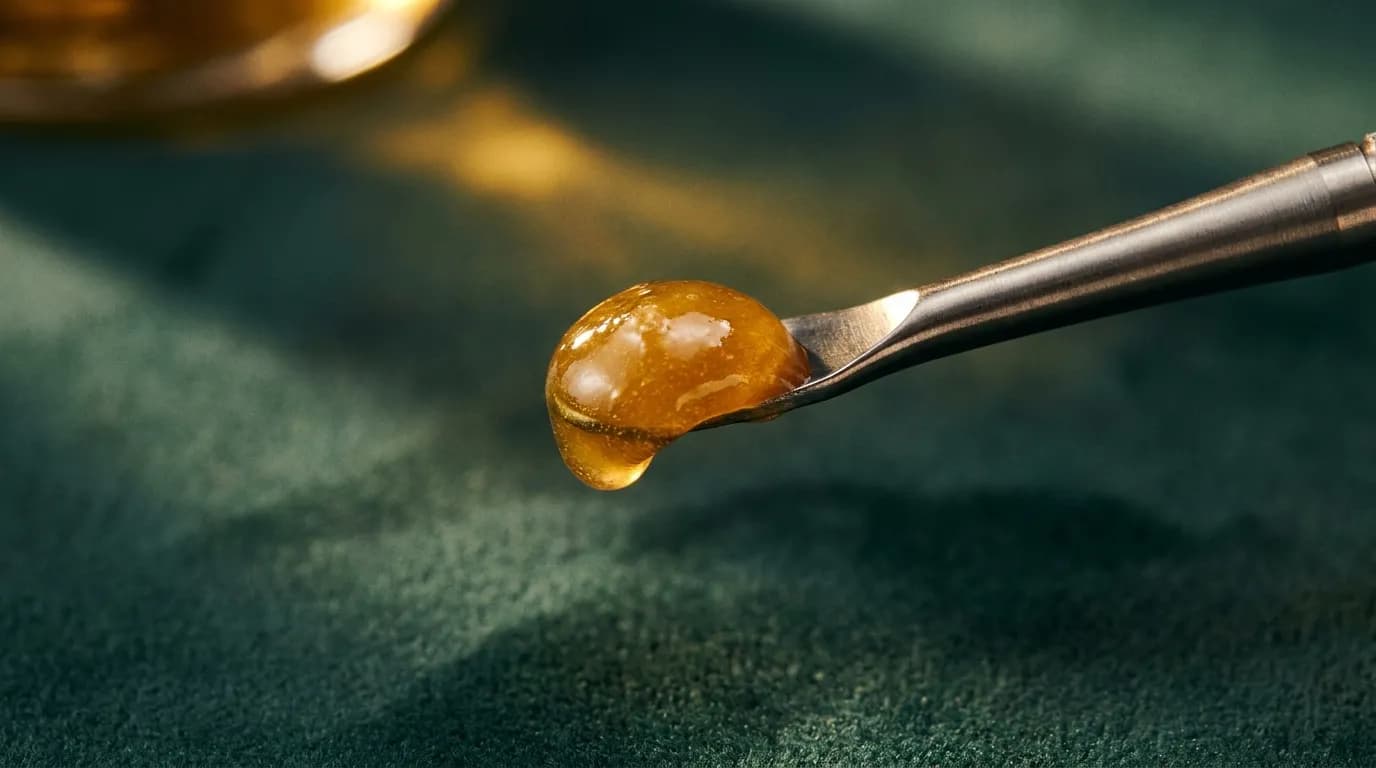
What Live Rosin Is
Live rosin starts with fresh-frozen cannabis. The plant is frozen right after harvest instead of dried and cured. It is then washed in ice water, which separates the trichome heads, where the cannabinoids and terpenes live, from the plant matter. That trichome material is dried into ice-water hash, then pressed under heat and pressure into a golden, translucent oil. That is live rosin.
The key distinction from other concentrates is the solventless process. Live resin, shatter, and wax use hydrocarbon solvents like butane or propane, or supercritical CO2, to pull cannabinoids from the plant. Live rosin uses only ice water, heat, and pressure, so no residual solvent ends up in the final product. The result is a concentrate that preserves the fresh plant's terpene profile, which is why the flavor is often described as fuller than solvent-extracted concentrates.
How To Consume Live Rosin
There are a few common ways:
Dabbing. A small amount, about a rice-grain for a starter dose, is vaporized on a dab nail or e-rig and inhaled. This is the most flavor-forward method.
Vape cartridge. Live rosin cartridges screw onto a standard 510-thread battery.
Disposable vape. Single-use pens need no battery or cartridge swap. Inhale to activate.
Flower top-coat. A little rosin added to a packed bowl or rolled into a joint adds flavor and potency to flower.
Edible. Some products infuse live rosin into gummies for an edible format.
Dose Considerations
Live rosin is much more potent by volume than flower, so a little goes a long way. If you are new to it, treat the dose carefully:
Start with a single small inhale, then wait about five minutes before a second.
For a dab, start around a rice-grain-sized amount.
Skip mixing your first time with alcohol or other substances, and drink water during and after.
First-time rosin users often overshoot because they apply flower-dose intuition, so err small.
Why Live Rosin Costs More
Solventless production is more labor-intensive and lower-yielding than hydrocarbon extraction. Making a gram of live rosin takes noticeably more starting flower than making a gram of live resin or wax, and the yield favors solvent-based methods. That production cost, plus the full terpene preservation, is what puts live rosin at the top of the concentrate shelf. Current prices for any specific lot are on the live menu.
How To Read A Live Rosin COA Before You Buy
A premium concentrate without a credible lab report is not premium. New York adult-use rules require every retail product to ship with a Certificate of Analysis from an accredited laboratory. For live rosin, the pages worth reading are the cannabinoid profile, the terpene profile, the residual solvent screen, the pesticide screen, the heavy metal screen, and the microbial screen.
On the cannabinoid profile, look at total THC and total CBD plus the minor cannabinoids like CBG, CBN, and CBC. On the terpene profile, a higher total terpene number generally points to a more flavorful, aromatic product. The residual solvent screen on a true solventless rosin should read non-detect, since no solvents are used in production; any real detection points to contamination somewhere upstream and should keep the product off the shelf. Pesticide and heavy metal screens follow the action limits set by New York regulators, and the microbial screen tests for the usual bacteria, yeast, mold, and pathogens. A budtender at either store can pull up the COA before you buy.
Solventless Versus Solvent-Based, In Plain Language
The most common question at the concentrate counter is whether live rosin is "better" than live resin. The honest answer is that it is different, not strictly better, and the right pick depends on you.
Live resin uses hydrocarbon solvents, usually butane or propane, to strip cannabinoids and terpenes from fresh-frozen plant material, and the oil is then purged of residual solvent. A well-made live resin passes its solvent screen and carries a bright, intense terpene profile, because solvent extraction pulls volatile terpenes efficiently. The tradeoff is that the process uses hydrocarbon solvents, which some people prefer to avoid.
Live rosin uses ice water, agitation, heat, and pressure, so it has touched only water and pressure. The terpene profile is often described as more nuanced, sweeter, and rounder than the sharper top-note of solvent-extracted resin, and the selling point is the total absence of solvent. Neither answer is wrong. It comes down to whether you prioritize the solventless process or the bright profile and typically lower price of resin.
Storage And Shelf Life For Solventless Concentrates
Live rosin keeps best sealed in glass. For longer storage, the fridge slows degradation; for the short term, a cool, dark drawer at room temperature is fine. Light and heat are the two main enemies, since heat and UV break down cannabinoids and drive off the volatile terpenes over time even in a sealed jar.
The tradeoff with cold storage is that cold rosin stiffens and gets harder to handle, so many people pull the jar out a little while before use, let it come up to a workable temperature, take what they need, and put it back. Kept well, live rosin holds its flavor for a good while; left in the sun or a warm room and opened often, it dulls a lot faster.
Cartridges and disposables are less storage-sensitive because the oil is sealed away from air. Store them upright, at room temperature, and away from direct heat.
Compliance Notes Specific To Concentrates
New York's adult-use possession limit on concentrate is commonly cited as 24 grams, separate from the flower limit. Concentrates must be transported in their original child-resistant packaging and may not be consumed in public spaces, vehicles, or workplaces. Sales and consumption are limited to adults 21 and over. Every product on a licensed New York shelf ships in compliant packaging with full label information and a COA you can pull up.
Where To Find The Current Drops
Which live rosin lots we have changes as processors release them and stock sells through. The live menu on thealchemy.nyc shows what is available at each store right now. You can also come into Chelsea or Flatiron and ask a budtender what is fresh on the concentrate shelf this week.
The Alchemy Editors
Field notes from the counter at Chelsea + Flatiron.
Written by our procurement and budtender team. Every claim verified against NYS OCM regulations and current shelf inventory. Updated as the menu rotates.
Continue reading
Next from The Alchemy Journal.
Pride in Chelsea
The short version: Pride Month runs all June, and the NYC Pride March traditionally steps off on the last Sunday of the month, along a route that runs through the Chelsea and Greenwich Village area. Confirm the exact date and route on nycpride.org before you head out. If you're celebrating with cannabis, choose lower-dose, well-paced formats, keep hydrated, never consume and drive, and remember that Pride is, before anything else, a commemoration of a fight for liberation.
Best Dispensary in Flatiron
The short version: The Alchemy at 12 West 18th Street is a licensed New York State adult-use cannabis dispensary in the Flatiron District, near Union Square and Madison Square Park. You'll need a valid 21+ government ID. You can pre-order online for pickup or get Manhattan delivery, and the counter is there to match you to the right product. The Alchemy Chelsea is open Monday and Tuesday 10am to 10pm, Wednesday to Saturday 10am to midnight, and Sunday 10am to 10pm. The Alchemy Flatiron is open Monday 9am to 9pm, Tuesday to Thursday 10am to 9pm, Friday 10am to 10pm, and Saturday and Sunday 10am to 8pm. Here's what to know before you go.
Where to Watch NYC's 4th of July Fireworks in 2026
The short version: the 50th Macy's 4th of July Fireworks light the sky over New York on Saturday, July 4, 2026, starting at roughly 9:25 PM once it is fully dark, and running about 25 minutes. For the first time, the show launches from three points at once: the Brooklyn Bridge, the Lower East River near the Seaport, and the Lower Hudson River with Jersey City. Official public viewing is along the FDR Drive in Manhattan and the Jersey City waterfront. Below is where to watch, what to do around the day, and how to enjoy the holiday responsibly with cannabis if you are 21 or older.