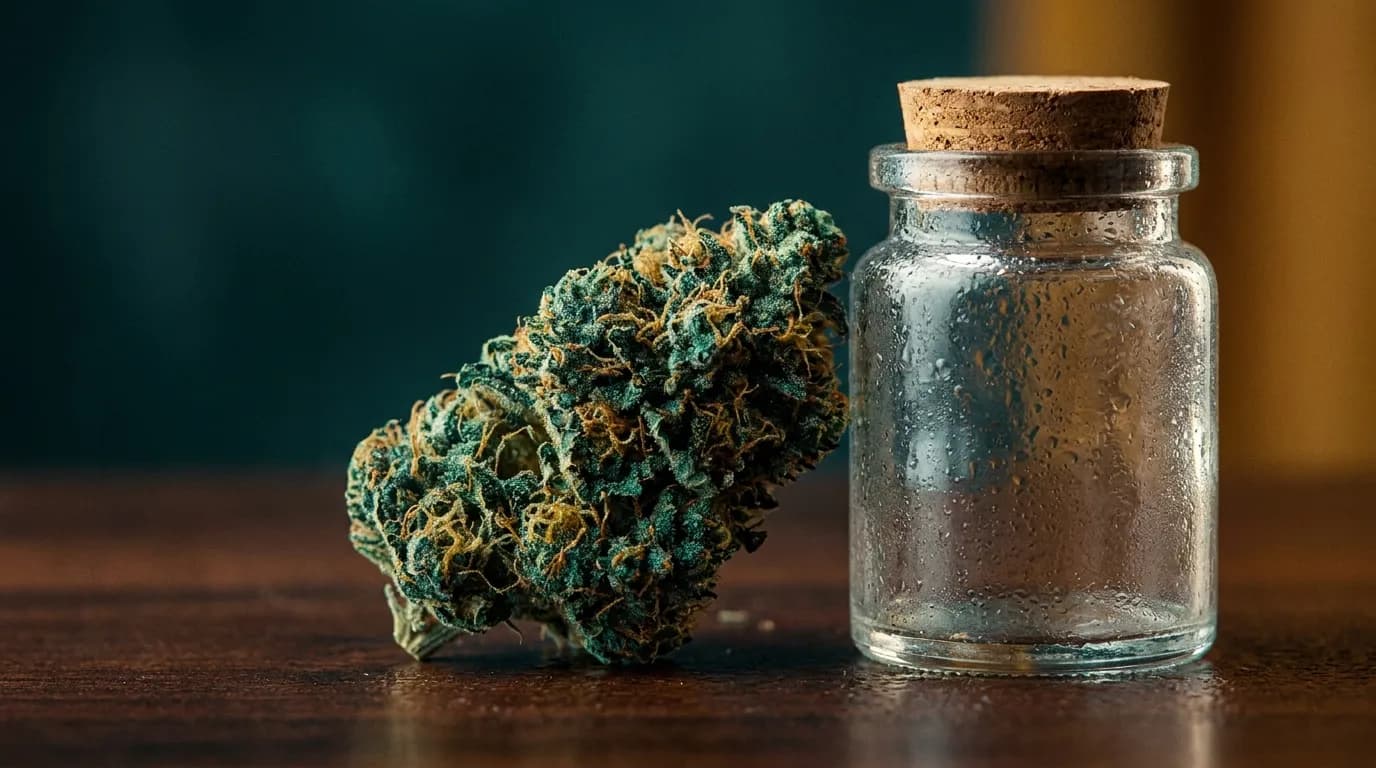
What Fresh Cannabis Should Look Like
Quality fresh cannabis exhibits the following visual signals:
Vivid color. Bright green is the most common, with cultivar-specific variations including purple, orange, blue, or brown undertones. The color should be vivid rather than washed out.
Visible trichomes. Trichomes are the resinous mushroom-shaped structures producing cannabinoids and terpenes. Quality cured cannabis shows clear visible trichome coverage on the buds. Trichomes often appear frosty or sparkly under good lighting.
Distinct pistils (hairs). The orange, red, or brown hairs (pistils) should be present. They indicate proper maturation. Heavy pistil coverage versus light pistil coverage varies by cultivar.
Compact but not tight bud structure. Indoor flower typically has dense compact buds. Sun-grown and greenhouse flower can have looser bud structure. Either is acceptable; what to avoid is buds that look airy, leafy, or stretchy.
No visible mold or mildew. White fluffy spots, gray fuzz, or unusual coloration indicate mold or mildew. Reject any bud showing these signs.
Smell Test
The aroma of fresh cannabis is one of the most reliable freshness indicators.
Strong, complex aroma. Quality fresh cannabis has a strong aroma when the jar is opened. The aroma should be complex with multiple notes (gas, citrus, pine, earth, floral, sweet depending on cultivar).
Distinct cultivar character. A "Wedding Cake" cultivar should smell like its expected profile (sweet, vanilla, slightly earthy). A "Sour Diesel" should smell like its expected profile (gas, citrus, sharp). Aroma weakness or off-character is a quality flag.
No hay or grass smell. Fresh cannabis does not smell like hay or grass. A hay or grass aroma indicates the cannabis was harvested too early or has been stored too long.
No ammonia or mildew aroma. A pungent ammonia smell or musty mildew smell indicates the cannabis has gone bad. Reject these products.
Texture And Touch
Touch test (perform with clean dry hands):
Springy but firm. Quality fresh cannabis is springy. A bud should compress slightly under finger pressure and rebound when released. It should not crumble to dust nor feel wet and limp.
Snap when broken. A small stem or bud should snap rather than bend or crumble. Snap means proper cure moisture content. Bend means the cannabis is too wet. Crumble means the cannabis is too dry.
Slightly sticky. Trichomes produce resin that gives cannabis a slightly sticky texture. Sticky is good. Dry and powdery is too dry. Wet and oozing is too wet.
Not dusty. Quality cannabis is not dusty. Dust on the bud surface suggests degradation or contamination.
Moisture Content And Cure
Cannabis moisture content typically ranges from 8 to 12 percent water by weight in quality cured flower. Below 8 percent the cannabis is too dry and brittle. Above 12 percent the cannabis is too wet and risks mold.
Most NYS-licensed processors include a humidity-control packet (Boveda or similar) in the package to maintain optimal moisture during retail storage.
Signs of optimal moisture:
Springy touch. Snap-not-bend stem break. Clean appearance with no dust or surface mold. Strong aroma on jar open. Smooth burn when consumed (not harsh from dryness, not damp from excess moisture).
Trichome Color And Maturity
Under magnification, trichome color provides additional maturity information:
Clear trichomes. The cannabis was harvested too early. Cannabinoid content is below peak. Effect is typically less pronounced.
Cloudy or milky trichomes. Peak maturity. Cannabinoid content is at the cultivar's potential. Effect is balanced.
Amber trichomes. Slightly past peak. THC has begun to degrade into CBN. Effect is more sedating, often described as "couch-lock" leaning.
Quality cured cannabis typically shows a mix of cloudy and amber trichomes with very few clear trichomes. The exact ratio depends on the cultivator's harvest preference.
Age And Storage
Cannabis quality declines over time even under optimal storage. Approximate timeline:
0 to 6 months from cure. Peak quality. Maximum cannabinoid and terpene retention.
6 to 12 months. Still excellent if properly stored. Some terpene loss begins.
12 to 18 months. Noticeable terpene decline. THC may begin converting to CBN.
Beyond 18 months. Significant degradation. Effect remains but is altered.
NYS regulations require cannabis to display the cultivation date or packaging date. Check the date on the Alchemy product when assessing freshness.
Storage Best Practices
Proper storage maintains freshness:
Airtight glass containers. Mason jars or similar opaque sealed containers. Avoid plastic for long-term storage as it can affect terpene content.
Cool, dark location. A drawer or cabinet at room temperature. Avoid heat sources and direct light.
Humidity-control packet. A Boveda 62 percent humidity packet maintains optimal moisture.
Single-cultivar storage. Store different cultivars in separate containers to prevent aroma cross-mixing.
No refrigeration. Refrigeration can produce condensation that affects flower quality.
No freezer storage. Freezer cycles can damage trichomes.
Signs To Reject A Product
Reject cannabis showing any of these:
White fluffy spots (mold). Gray fuzz (mildew). Strong ammonia smell (bacterial decomposition). Musty hay or grass smell (over-aged or under-cured). Visible insects, webs, or droppings (pest contamination). Dust or powder coating (degradation). Wet or limp texture (excess moisture). Crumbles to dust on touch (over-dried).
The Alchemy buyer team inspects incoming inventory for these signs. If you receive a product with any of these issues, return it.
The Cure Science Behind Freshness
Cannabis freshness is a chemistry question with three primary variables: moisture content, terpene retention, and cannabinoid stability. A properly cured flower at 11 percent moisture content retains its terpene profile and its cannabinoid loading for months under good storage. The same flower dried to 6 percent moisture content loses terpenes rapidly because the volatile compounds escape more easily from over-dried plant tissue. The same flower at 16 percent moisture content develops bacterial and fungal contamination quickly because microbes thrive in higher humidity.
The cultivator's cure room balances these variables. The drying phase runs at 60 to 65 degrees Fahrenheit and 55 to 60 percent relative humidity to bring fresh-cut plants from 75 percent moisture to roughly 12 to 13 percent moisture over 7 to 14 days. The cure phase that follows runs at 60 to 65 percent relative humidity in sealed containers, with periodic "burping" (opening containers to release accumulated gases and equalize humidity) during the first 2 to 4 weeks. Properly cured flower exits the cure room at 10 to 12 percent moisture with stable terpene profile and meaningfully reduced chlorophyll-related harshness.
Retail storage preserves the cure-room work. The 62 percent humidity Boveda pack is the industry standard for retail and home storage because it maintains the optimal moisture window without active intervention. Boveda packs work bidirectionally: they release moisture if the surrounding air is below 62 percent humidity and absorb moisture if the surrounding air is above 62 percent.
The Olfactory Hierarchy Of Fresh Cannabis
A trained budtender can rank cannabis freshness primarily by aroma alone, and the hierarchy of olfactory signals is consistent across cultivars. The strongest signal of freshness is the immediate aroma intensity when the jar is opened: a properly cured fresh jar produces a wave of complex aroma that fills the space within a few seconds. A degraded jar produces a duller aroma that does not project as strongly. The second signal is aroma complexity: a fresh jar shows multiple terpene notes (the gas register, the citrus register, the pine register, the dessert register depending on cultivar). A degraded jar shows fewer notes and often a generic background herbaceous character that dominates the cultivar-specific notes.
The third signal is aroma off-notes: a fresh jar smells clean. A degraded jar may smell faintly of hay (over-drying), faintly of grass (under-cure), faintly of ammonia (bacterial decomposition), faintly of mustiness (mold or mildew), or faintly of dust (oxidation and air exposure). Any of these off-notes indicates the jar has lost meaningful freshness even if the cannabis is still consumable.
The Alchemy front-of-house team is trained to do a quick aroma check on customer-requested jars before sealing them in the bag. Customers who want to verify freshness themselves can ask to smell a jar at the counter; many budtenders will accommodate the request for premium-tier products particularly.
Specific Cultivar Aroma Profiles For Reference
A few common cultivar profiles to calibrate your nose against:
Wedding Cake: sweet, vanilla, slight earthiness, light citrus undertone. A fresh jar smells like a baked good with a green plant base.
Zkittlez: fruit-forward, candy-sweet, tropical, slight pine. A fresh jar smells almost confectionery.
Sour Diesel: gas, citrus, sharp, slight pine. A fresh jar smells like a gas station with a citrus peel undertone.
Gelato: sweet, dessert, slight floral, slight gas. A fresh jar smells creamy.
GMO (Garlic Cookie): pungent garlic, slight onion, gas, slight chocolate. A fresh jar smells aggressively savory.
Wedding Pie: sweet bakery base with stronger floral than Wedding Cake. A fresh jar smells like a pastry shop.
If a customer cracks a Wedding Cake jar and smells primarily green herbaceous notes with little vanilla character, the jar is either degraded, mis-labeled, or a low-quality phenotype. Same logic across all cultivars: the expected aroma profile is the freshness reference.
Common Causes Of Freshness Loss In Home Storage
A few patterns recur in customer questions about home storage problems. Leaving the jar open during a session: even 60 seconds of air exposure begins to degrade terpenes. Close the jar between uses. Storing the jar near a heat source (oven, sun-warmed windowsill, top of refrigerator): heat accelerates terpene loss and trichome degradation. Move the jar to a cool dark location. Storing cannabis in plastic bags long-term: plastic absorbs terpenes and can leach compounds back into the flower. Use glass containers for storage longer than a few days. Failing to use a humidity pack: cannabis stored without humidity control dries out in weeks rather than months. A $4 Boveda pack extends shelf life substantially. Using the same jar across multiple cultivars: aroma transfer occurs even between sealed jars over weeks; use single-cultivar storage if you care about the profile.
The home storage system that works for most NYC consumers is a set of small glass jars (4 oz mason jars work well), each with a 62 percent Boveda pack, each labeled with the cultivar name and purchase date, kept in a cool dark drawer away from kitchen heat sources.
Sun-Grown And Greenhouse Versus Indoor Freshness Signals
The freshness signals adjust slightly based on cultivation method. Indoor flower typically presents the tightest bud structure, the most uniform color, and the most consistent cure window. Sun-grown flower presents looser bud structure and can have more color variation within a single jar; this is not a freshness flag in sun-grown, just a cultivation-method signature. Greenhouse flower sits between the two; bud structure is typically tighter than sun-grown but looser than indoor.
The aroma and texture signals work the same across all three cultivation methods. A properly cured sun-grown jar smells as complex as a properly cured indoor jar, snaps as cleanly when broken, and feels as appropriately sticky on the trichome side. The cultivation method affects the shelf signature; the cure quality affects the freshness signals.
When To Return A Product To The Alchemy
The Alchemy returns policy covers products that fail freshness assessment at customer pickup or shortly after. Mold or mildew visible in the jar, ammonia or musty off-notes on first jar opening, severe over-drying that crumbles on touch, or any visible foreign contamination are returnable for refund or exchange. Bring the receipt, the product in its original packaging, and a description of the issue. Returns at both Chelsea and Flatiron locations are processed at the front desk.
Returns for "didn't get me as high as I wanted" or "I don't like the cultivar character" are not freshness returns; those are customer-preference returns and follow a separate policy with limited eligibility. Freshness returns are clear-cut: the product failed a quality standard the customer reasonably expects.
The Alchemy Editors
Field notes from the counter at Chelsea + Flatiron.
Written by our procurement and budtender team. Every claim verified against NYS OCM regulations and current shelf inventory. Updated as the menu rotates.
Continue reading
Next from The Alchemy Journal.
nyc cannabis laws
NYC Cannabis Laws In 2026
The single most common question at our Chelsea and Flatiron counters has nothing to do with strain selection. It is some variation of, "wait, is this actually legal?" The answer is yes, with conditions, and the conditions are not what most New Yorkers think they are. The state legalized adult-use cannabis in March 2021. The first licensed dispensary opened to the public in December 2022. By the time you read this, the regulated market has been operating for roughly three years, and the gap between what the statute says and what enforcement looks like on the street has narrowed considerably. This guide walks through the law as it stands in 2026, the regulatory body that runs it, the possession limits, the consumption rules, the workplace protections, the employer carve-outs, the unlicensed-shop crackdown, and what visitors from outside New York actually need to know before they buy.
cannabis terpenes guide
Terpenes 101
The conversation that changes how most customers buy cannabis happens about three minutes into their second visit. They picked something on visit one based on the THC percentage on the front of the label, the experience landed differently than they expected, and they came back asking why two strains at the same THC number produced two completely different evenings. The answer lives on the second page of the Certificate of Analysis, in the section most first-time buyers never look at. Terpenes are the variable that explains the gap between potency and effect, and once you understand the eight that dominate cannabis chemistry, you can predict the experience of a cultivar you have never tried with reasonable accuracy. This guide walks the science, the practical reading method, the eight major terpenes individually, the entourage effect literature, and how the NYS-licensed cultivator market is starting to surface this data in ways the legacy gray market never did.
Q2 2026 Menu Update
The Alchemy NYC menu refreshes quarterly with new cultivars, new processors, new product types, and rotating limited releases. This Q2 2026 update documents what changed in April, May, and June 2026 across both Manhattan locations.